

Most homeowners find out about HOA landscape lighting rules the hard way. The violation notice arrives. Two weeks after installation, the new path lights are in the ground and the letter is in the mailbox asking for removal or a formal appeal. This happens constantly in communities across Calabasas, Thousand Oaks, and Westlake Village, where HOA enforcement runs on real authority and regular property audits. Thing is, the rules were always there. They just weren’t front of mind until the notice showed up. HOA landscape lighting rules cover everything from lumen caps and fixture finish requirements to operating hour limits and color temperature standards. Knowing them before you install saves a real round of costs.
Why HOA Landscape Lighting Rules Exist
Short version: neighbor complaints. Light that reads perfectly fine from your driveway is a different experience from the house next door. The neighbor whose bedroom window faces your front yard is living with your new uplights in a way you never will from inside your own home. You’re inside. They’re trying to sleep. HOA lighting rules exist because that gap is real and complaints follow quickly.
Light Pollution and the Dark Sky Movement
The shift happened gradually. Five, maybe eight years ago, most HOA lighting rules were vague. Now they’re specific. Malibu communities, the Santa Monica Mountains foothills, and Simi Valley hillsides pushed the earliest enforcement because those locations sit close to open land where light pollution is obvious year-round. That turned neighbor complaints into board policy. Most boards working from that shift now reference the Illuminating Engineering Society’s framework: fixtures fully shielded to throw light straight down, color temperatures at 3000K or below, nothing that rotates, pulses, or flashes.
Aesthetic Consistency Across the Community
Here’s the other driver. The community’s look is part of what every homeowner on the block paid for, and a lighting mismatch is one of the faster ways to erode it. A street of Spanish Colonial homes running warm amber path lights starts to feel off when one property installs cool white spotlights and brushed stainless bollards. That mismatch doesn’t stay contained to the one property that changed. It reads across the whole block. People buying into HOA communities paid, at least partly, for a specific look. The lighting rules are how the association keeps that look intact.
The Most Common HOA Landscape Lighting Restrictions
Rules differ by community, but certain categories show up in nearly every HOA across Los Angeles and Ventura Counties. These are the areas that almost always require review before anything new goes in.
Brightness Limits and Color Temperature
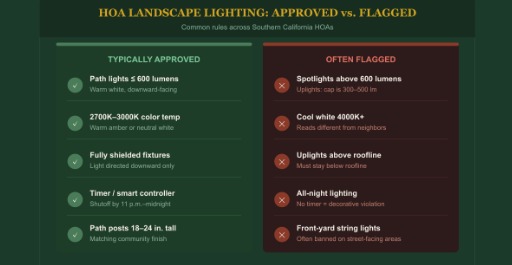
Path and garden lights are typically capped at 400 to 600 lumens per fixture. Spotlights and street-facing uplights have their own lower ceiling, usually 300 to 500 lumens for anything visible from the curb. Most homeowners check the lumen number and stop there. Color temperature is where they get caught. HOAs want warm white, 2700K to 3000K. Get into the 4000K range and the cool tone is visible from three houses away. Not just from next door. Formal complaints follow quickly. The specific numbers vary by community, which is why pulling the actual guideline document before buying fixtures is the only reliable move. Don’t assume. Look up the spec.
The National Fire Protection Association covers the electrical side: grounding requirements, weatherproofing ratings, wire burial depth for low-voltage systems. Clearing those is a separate track from HOA approval. A fixture that checks every electrical box still has to clear the committee on brightness and placement. Two different requirements. Neither one waives the other.
Fixture Style, Height, and Placement
Finish requirements surface more than most homeowners expect. Some HOAs give you a short approved list: oil-rubbed bronze, matte black, architectural pewter. Others only require that fixtures be non-reflective. Post heights for path lights are commonly capped at 18 to 24 inches, and bollard lighting taller than 36 inches typically triggers a full architectural review regardless of lumen output or finish chosen.
Placement tends to be where things get complicated. Street-facing uplights have to be shielded and aimed below the roofline. That’s a written requirement in most HOAs, not a suggestion. Wall sconces and soffit lights that face the street need to work visually with what the neighbors are running. String lights on front yard fences or any fence line visible from the sidewalk are banned in a lot of managed communities. Backyard is a different story. Most HOAs give considerably more latitude back there, but anything facing the street gets reviewed.
Operating Hours and Smart Controller Requirements
Look, landscape lighting that runs all night generates complaints. If the block goes dark by 10 p.m. and yours is still on at 2 a.m., the neighbor whose bedroom window faces your front yard is going to notice. Most HOAs responded by writing a shutoff into the rules: timer or smart controller required, off by 11 p.m. or midnight. That shows up most in communities built after 2015.
Motion-activated security lighting typically gets more lumen latitude. The HOA’s logic: a security light kicks on when triggered and goes off. A fixture that stays on from dusk to dawn isn’t functioning that way, regardless of what you called it at installation. Continuous operation puts it under decorative lighting rules. What you labeled it when you bought it doesn’t matter.
How the HOA Approval Process Actually Works
Most HOAs require an ARC submission before any landscape lighting goes in. That applies even to simple installations that don’t need a city permit. Skip it and you’re looking at a violation path significantly harder than approval would have been.
What a Complete Submission Looks Like
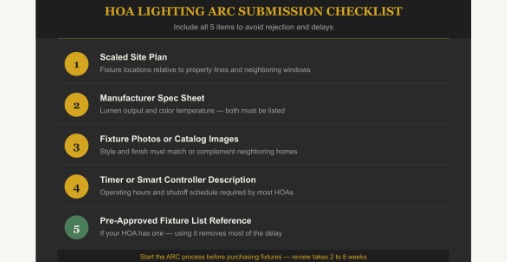
The submission package needs a few things: a scaled site plan with fixture locations relative to property lines and neighboring windows, manufacturer spec sheets listing lumen output and color temperature, photos of the fixture style and finish, and a description of the timer or controller schedule. If your community has a pre-approved fixture list, using it cuts most of the review delay. The committee already vetted those fixtures. You’re not starting from scratch.
Timeline is what most homeowners underestimate. Some communities respond within two weeks. Others meet monthly, which means a submission sent the day after a meeting waits nearly a month before anyone looks at it. Start the ARC process before buying fixtures. (One other thing: an incomplete submission doesn’t restart a fast-track. It just adds another full review cycle.)
What Gets Rejected and Why
The rejections that come back most often are for lumen output exceeding the community cap, fixture styles that don’t meet the architectural requirements, or placement that pushes light onto neighboring properties. Most rejections include specific written feedback on what needs to change. Read it carefully before responding.
In practice, this is where experienced landscape lighting contractors earn their fee most have been through enough ARC cycles across LA and Ventura County to know what a given committee actually wants to see, and can put together compliant fixture documentation as part of the install rather than after a rejection. That matters more than it sounds like when the review cycle runs several weeks and you’re working around an installation schedule.
When the HOA Flags Your Existing Lighting
Violation notices on landscape lighting are more common than most homeowners expect. New property managers, new board members, periodic audits: all of them surface lighting that doesn’t meet current standards. Sometimes nothing changed. The community tightened its guidelines, the old fixtures don’t meet the new ones, and the notice shows up anyway.
Resolving it comes down to two directions: modifying the flagged fixtures to meet current standards, or removing them and going through the ARC process before reinstalling. The HOA’s written feedback tells you specifically what needs to change. Read it before you respond, because a response that doesn’t address the exact item will generate the same flag in the next audit. Some violations are a straightforward fix: one fixture type runs above the lumen cap, and a direct replacement resolves it. Others involve placement or style problems that need a fuller redesign before the committee will sign off.
The deadline is the part to take seriously. Most communities allow 30 to 60 days for corrections. Let that slide and fines start. In HOAs with real enforcement authority, the association can hire a contractor directly and charge the homeowner the full cost of the work. Understanding the most common landscape lighting installation mistakes that trigger HOA flags helps you address a violation correctly the first time and avoid a second notice.
What HOA Landscape Lighting Rules Mean for Your Project
HOA landscape lighting rules protect two things: the community’s visual consistency and neighbors’ reasonable expectation of a dark exterior at night. And honestly, across the San Fernando Valley, the Conejo Valley, and the coastal LA corridor, those rules have gotten more specific every year as light pollution becomes a harder problem to ignore.
Understanding the restrictions before you install is the difference between a project that wraps up cleanly and one that ends in a violation notice and a second round of costs. Start with the ARC process, not the fixture catalog. Get the current lighting guidelines from your HOA management office before selecting anything. Check lumen output, color temperature, and fixture finish against those numbers. If your community has a pre-approved fixture list, work from it. And if you’re planning a larger installation covering path lights, facade uplights, and smart controls, work with a contractor who knows the HOA approval process in your specific community before the order is placed, not after.

